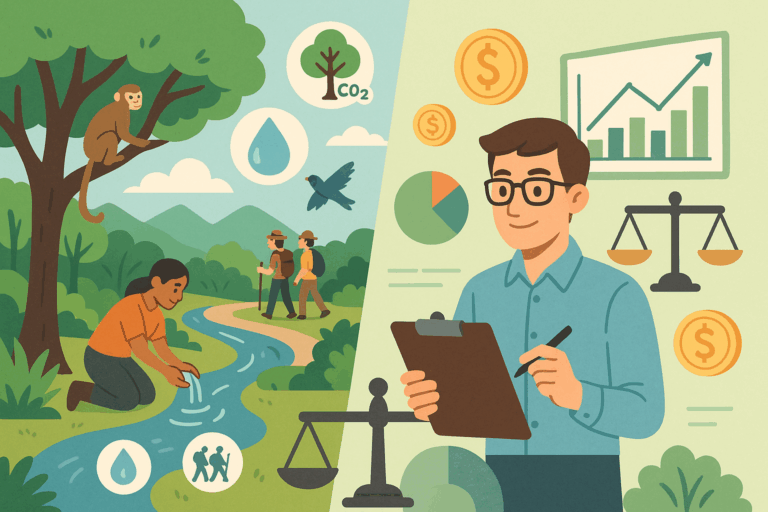
Although the use of economic tools in conservation has grown in recent years, conservation is still often approached primarily through the lens of ecology, biology, and the urgency of preserving our planet’s biodiversity. In my own work, I have often observed a sense of discomfort among many conservationists regarding the use of economics, particularly around the economic valuation of ecosystem services. To be fair, their concerns are valid: the idea of assigning monetary value to nature can feel reductive. Furthermore, attempting to convey the value of nature as a financial metric will always carry some level of controversy, as experts in different fields may disagree on the key assumptions underpinning valuation exercises.
Despite these challenges, incorporating economics into conservation is essential for two key reasons. First, it makes communication with policymakers—whose primary focus is often on financial measures of costs and benefits—more effective. When we can demonstrate that the benefits of protecting nature outweigh the costs, it becomes significantly harder for policymakers and other decision-makers to refute conservation arguments. Second, protecting nature requires substantial financial resources, and relying solely on donations, government grants, or funding from development banks and foundations is often insufficient to close the existing funding gap. Increasingly, attention has turned to the private sector—companies and investors—as a vital source of financial support. To attract private investments, we must build a compelling business case that demonstrates conservation is a smart decision not only environmentally and socially, but financially as well.
For these reasons—and undoubtedly many others—integrating economic principles into conservation strategies is not merely optional. Rather, it is a fundamental step toward developing sustainable, long-term solutions that benefit both nature and society.