Natural capital accounting:
correcting the structural flaw in GDP measurement
There are many debates surrounding the use of Gross Domestic Product (GDP) as the primary measure of a country’s economic health. Here, we will focus on how GDP fails to account for environmental depreciation and how Natural Capital Accounting (NCA) can be used to mitigate this limitation.
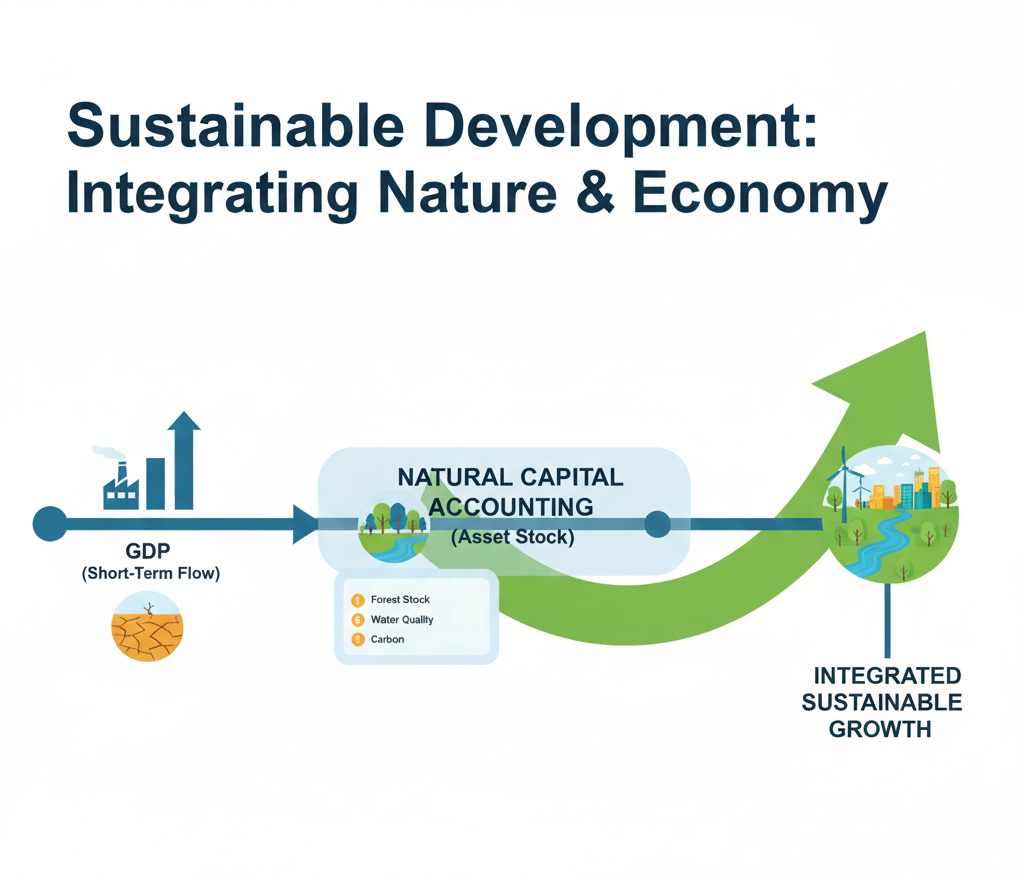
From a sustainability perspective, the most important limitation is the fact that GDP is a measure of flow and not stock. GDP tracks the aggregate flow of final goods and services over usually a one-year period. This definition means that GDP structurally fails to account for the depreciation or degradation of natural assets, even though nature plays an important role as an input for almost all finished products and services accounted for in GDP.
This situation creates a problem in the sense that the degradation or depletion of a natural resource (such as a forest or a mineral deposit) is registered as a positive contribution to the current flow of production. For example, when a company extracts a resource, like cutting down a tree for timber, mining coal, or pumping oil, it is engaging in a productive activity. The sale of that raw timber, coal, or oil is registered as output, which contributes positively to the national flow of income. Crucially, while the consumption of manufactured capital (machinery wear-and-tear) is deducted in national accounts, the loss of the underlying natural capital stock (environmental depreciation) is omitted.
This structural omission represents significant economic and social risks in the future. In the long run, nature’s degradation will directly impact future production capacity and, consequently, the country’s economic health. Thus, decision-makers relying on GDP as the main indicator of a nation’s health are, by definition, operating with incomplete information about the true state of their productive capital.
Within this context, NCA offers a potential corrective. NCA provides the standardized data necessary to link nature’s stock to the production flow. This data, organized within the UN System of Environmental-Economic Accounting (SEEA) framework (in the case of countries), enables an improved understanding of potential current and future environmental risks that can greatly improve economic decision-making.
Therefore, once countries conducted their natural capital accounting, the following step is to integrate nature’s health into standard economic models. This means explicitly incorporating environmental capital as a factor in the production function so that we have a more robust mechanism for forecasting economic outcomes. Some companies are already using NCA to understand how changes in natural capital directly affect their supply chain risk, operational costs, production volume, and long-term revenues.
However, integrating these links at the national level presents greater methodological and measurement challenges. Nevertheless, this integrated approach is a way to guarantee that countries grow not only in size (GDP), but also in people’s quality of life (social well-being) and the conservation of natural resources.