The multiple effects of protected area tourism
Protected areas are often viewed solely as conservation units. However, when they allow visitors, they can generate important additional benefits for local economies.
When a tourist visits a protected area, they do more than pay an entrance fee. They also spend money on local hotels, restaurants, guides, transport, and shops. This spending creates spillover effects in the local economy, generating income and employment, particularly for nearby communities. These effects are typically measured using economic multipliers, calculated from Input–Output tables or Social Accounting Matrices derived from national accounts.
But what are economic multipliers?
There are two main types of multipliers commonly used in economic impact analysis:
- Type I multiplier = Direct effects + Indirect effects
- Type II multiplier = Direct effects + Indirect effects + Induced effects
To make this more intuitive, a common way to think about multipliers is as a stone thrown into a lake.
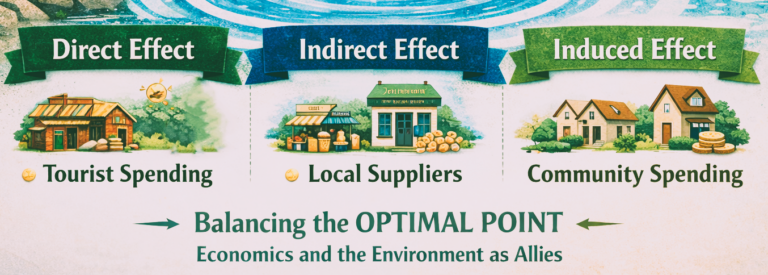
- Direct effects are the first wave: the money tourists spend directly on goods and services, such as accommodation or local guides.
- Indirect effects are the subsequent waves: hotels purchase food from local farmers, guides buy equipment, and service providers consume energy and supplies.
- Induced effects are the returning movement of the water: employees in hotels, farms, and service businesses spend their wages in the local economy, further stimulating economic activity.
By estimating Type I and Type II multipliers, we can show that the economic value of a protected area extends beyond conservation alone, as it can generate income and employment for surrounding communities.
The challenge of overtourism and the “optimal point”
However, not everything is positive. Excessive visitation can undermine the very assets that attract tourists in the first place: nature.
So how do we identify an optimal level of tourism? From an environmental economics perspective, the goal is not to maximize economic multipliers, but to respect the carrying capacity of the ecosystem. The optimal point is not where profits are highest, but where socioeconomic benefits are balanced with the maintenance of ecological integrity and healthy ecosystems.
When environmental impacts, such as waste generation, erosion, or wildlife disturbance, grow faster than local employment and income, this is a clear warning sign. One useful indicator in this context is the capture rate, which measures how much tourism revenue actually remains in the local economy. If tourism grows but local income does not, communities bear the environmental costs of overtourism without receiving its social benefits.
Economics and the environment as allies
From Yellowstone to Iguazú Falls, tourism in protected areas demonstrates that economics and ecology can speak the same language. Measuring these impacts provides park managers and policymakers with evidence to argue that investment in protected areas need not be a financial burden. When managed sustainably, protected areas can function not only as environmental policy instruments, but also as powerful regional development strategies.