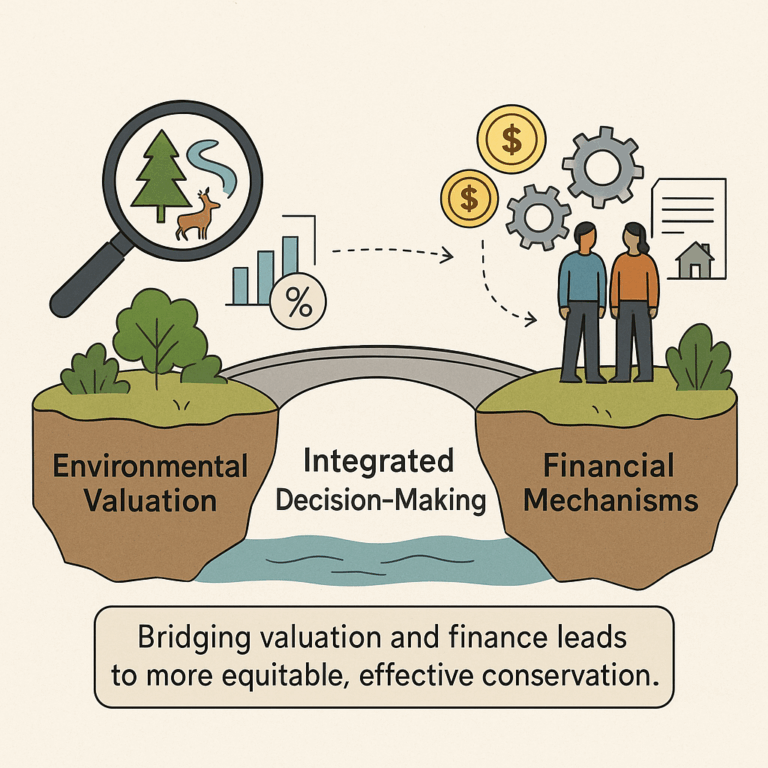
I’m currently working on a project to value ecosystem services and create ways to fund their protection. While working on this project, I’ve noticed that the relationship between environmental valuation and financial mechanisms is often not well understood. In fact, their connection is not always straightforward. So here are my two cents:
Both environmental valuation and financial mechanisms are key components of a broader conservation planning strategy. Environmental valuation aims to estimate the monetary value of environmental goods and ecosystem services such as climate regulation and recreational opportunities, which provide significant benefits to human well-being. It is a great tool for showcasing the benefits of conservation efforts—but the numbers coming from those exercises are not often used in actual environmental policy.
In contrast, financial mechanisms—such as Payments for Ecosystem Services—are tools to translate conservation goals into actionable strategies. These mechanisms tend to rely more on cost-related data, such as implementation, transaction, and opportunity costs.
Taken together, the link between valuation and financial mechanisms may not be immediately obvious, largely because of their different focal points. While valuation emphasizes the benefits of conservation, financial mechanisms focus on the costs of achieving it. But these tools are not at odds—they are complementary within an integrated conservation strategy.
In this sense, to truly integrate environmental valuation and financial mechanisms, we need to bridge the gap that often exists between them in practice. Valuation is frequently treated as a separate, conceptual exercise, while financial mechanisms are designed with cost, feasibility, and implementation in mind. But when used together—such as using valuation insights to set payment levels or identify priority beneficiaries—these tools can reinforce each other and support more strategic, equitable conservation outcomes.