Why is every conservation choice an optimization problem?
Being an environmental economist, I am biased in advocating for development paths that prioritize social and financial returns alongside rigorous environmental conservation. However, the question I have been asking myself nowadays is not whether we should protect a natural resource, but rather: what are we optimizing for?
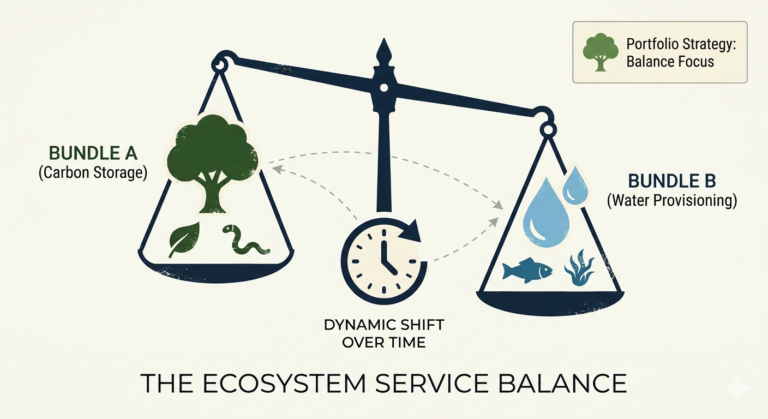
Nature operates under the same fundamental principles as any other economic asset. It is a finite resource, and as such, it cannot simultaneously be at the absolute maximum of every potential ecosystem service. When a landscape is managed to enhance one specific output, it often needs to redirect finite inputs, such as nutrients, solar energy, or water, away from others. Consider, for example, a forest landscape. If managed exclusively for timber production, the ecosystem’s capacity to function as a carbon sink or to provide watershed regulation will be compromised (Raudsepp-Hearne et al., 2010).
Although these trade-offs are most visible under human management, they remain an inherent feature of even the most remote ecosystems (Jiang et al., 2023). Indeed, in a remote, natural state, the optimization problem is dictated by evolutionary pressures and biophysical limits. Ecosystem services may appear complementary at low levels of intensity; however, as any system approaches its production possibility frontier, trade-offs become unavoidable (Trubins, 2023).
This is why it is important for economists to collaborate closely with ecologists. When we protect an area, we are not simply saving a neutral good; we are actively deciding which bundle of services to prioritize (Raudsepp-Hearne et al., 2010). If we fail to acknowledge these biophysical constraints, we risk misallocation such as the carbon sequestration vs water yield example (Dade et al., 2018).
It is true that at this point, one might argue: isn’t it better to just protect rather than adding complexity to an already challenging decision-making system? I would agree 100%. However, the point I am making is about management, and how to better reach environmental targets now and in the future, considering that even the most “passive” conservation policy is usually maximizing a bundle of ecosystem services.
All in all, by assuming a specific conservation path, we should ask:
- What are the ecosystem services we are prioritizing today?
- What are the implications of this choice for the future (given that nature is a dynamic, shifting system)?
- How does this choice change the long-term valuation of these ecosystem services?
From an economic perspective, my interest lies especially in the last bullet point. The way we have been conducting standard environmental valuation usually relies on the assumption of a constant flow of ecosystem services. While we know this is an unrealistic simplification, it remains our standard baseline. However, I wonder how complex it would be to relax this assumption? Based on recent research, it seems it is computationally and theoretically hard, but attempts are being made, and soon we should shift toward dynamic valuation.
References
Dade, M. C., Mitchell, M. G. E., McAlpine, C. A., & Rhodes, J. R. (2018). Assessing ecosystem service trade-offs and synergies: The need for a more mechanistic approach. Ambio, 48(10), 1116–1128. https://doi.org/10.1007/s13280-018-1127-7
Jiang, W., Gao, G., Wu, X., & Lv, Y. (2023). Assessing temporal trade-offs of ecosystem services by production possibility frontiers. Remote Sensing, 15(3), 749. https://doi.org/10.3390/rs15030749
Raudsepp-Hearne, C., Peterson, G. D., & Bennett, E. M. (2010). Ecosystem service bundles for analyzing tradeoffs in diverse landscapes. Proceedings of the National Academy of Sciences, 107(11), 5242–5247. https://doi.org/10.1073/pnas.0907284107
Trubins, R. (2023). Trade-offs in ecosystem services: Clarifying concepts and measuring severity within the production possibility frontier framework. Sustainability, 15(24), 16763. https://doi.org/10.3390/su152416763